


An AC Unit can be top-of-the-line, yet if the air can’t travel through the house the way the designer planned, comfort and efficiency plummet. That travel happens inside HVAC ductwork—a hidden pathway that deserves more attention than it often gets.
This article lays out what ducts are, how the system is built, which ductwork types are common, how installers put everything together, and the best ways to keep it working for decades. We’ll finish with several design flaws to watch for and a quick note on why our crew is your best choice when you need help.
What Is an Air Duct?
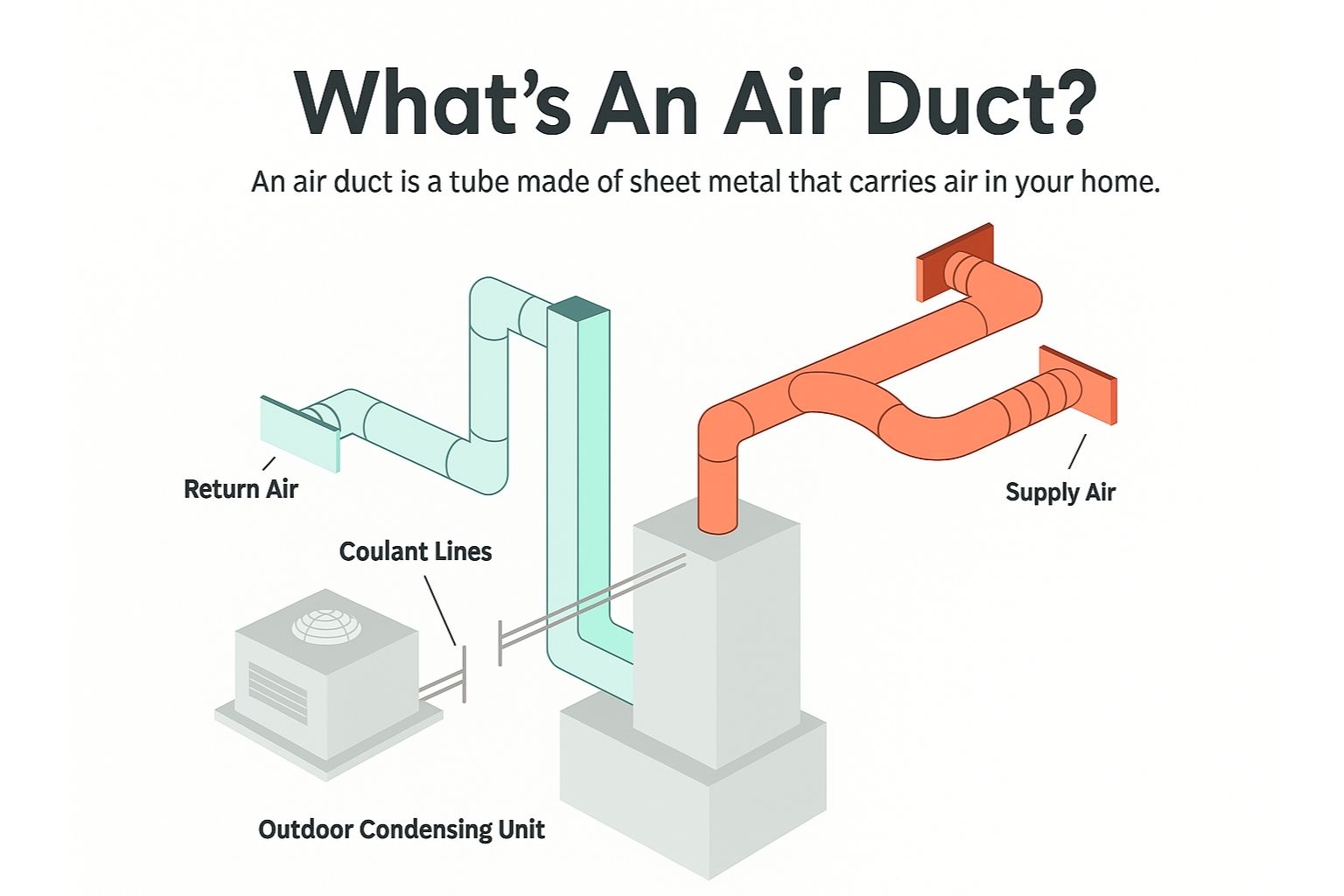
An air duct is a hollow channel that moves heated or cooled air between your equipment and each room. On the supply side, it pushes conditioned air out; on the return side, it brings room air back for filtering and tempering. A well-sealed duct keeps temperature loss and dust gain low, so the blower doesn’t waste power overcoming leaks.
Main Parts of Your HVAC Ductwork and How They Work
| Component | Purpose | Key Points for Homeowners |
| Supply plenum | First chamber, leaving the air handler | Must be sized for full system airflow to avoid bottlenecks |
| Supply trunk | Main “highway” that branches feed from | Often, rectangular sheet metal running the length of the basement or attic |
| Branch ducts | Smaller runs that serve individual rooms | Can be sheet metal, flex, or fiberboard; length and diameter control the room airflow |
| Take-offs & reducers | Fittings that connect trunks to branches | Smooth take-offs reduce turbulence and noise |
| Volume dampers | Plates that adjust the airflow inside a run | Essential for balancing multi-level homes |
| Registers & grilles | Visible covers on floors, walls, or ceilings | Adjustable blades let occupants fine-tune direction |
| Return ducts | The pathway that pulls air back to the equipment | Should be as airtight as supply lines to prevent dust |
| Return plenum & filter rack | Entry point to the furnace or air handler | Houses the air filter—replace or clean it on schedule |
| Supports & hangers | Straps, saddles, or rails that hold ducts | Prevent sagging that could trap moisture or restrict flow |
| Insulation | Wraps or internal liners that limit heat gain/loss | Especially important in unconditioned attics or crawl spaces |
Key Ductwork Types

| Duct Type | Key Facts | Pros | Cons |
| Sheet metal duct | Galvanized steel or aluminum, joined with drive cleats or round snap-lock seams | Rigid, smooth interior, easy to clean, resists mold | Higher material cost; pieces must be sealed at every joint |
| Flexible duct | Plastic liner over a wire helix, blanketed with insulation and vapor jacket | Bends around framing quickly, is lighter to handle, and lower cost | Can kink or crush; rough inner coil adds friction; needs tight strapping every 4–5 ft |
| Fiberboard duct (fiberglass duct board) | Foil-faced, rigid fiberglass board scored and folded into shape | Built-in insulation, good sound dampening, lighter than metal | Rough interior increases pressure drop; must stay dry; edges shed fibers if not sealed with approved tape/mastic |
Note: Contractors use “fiberboard duct” and “fiberglass duct board” for the same product. Both terms refer to pressed fiberglass panels that deliver R-value and quiet operation in one package.
Step-by-Step Guide to Ductwork Installation

For a smooth and easier installation, follow these steps:
- Room-by-room load calculation – Manual J or similar software figures out how many cubic feet per minute (CFM) each space needs.
- Duct layout and sizing – Using Manual D rules, the designer selects trunk and branch sizes that provide the required CFMs without exceeding the blower’s static pressure limit.
- Material choice – Decide where sheet metal duct makes sense (long straight runs), where flex is acceptable (short drops), and where fiberboard panels can cut noise (finished basements).
- Prefabrication – Metal is cut, notched, and rolled; fiberglass sheets are scored with a V-groove cutter; flex lengths are measured to prevent slack.
- Hanging and supporting – Metal gets strapped every 4 ft, flexed every 5 ft with wide saddles to avoid compression. Fiberboard panels rest on raised cleats or hangers to keep them off damp concrete.
- Joining and sealing – Installers apply water-based mastic or UL-181 metal tape to every seam. Testing aims for total leakage under 5 percent of system airflow.
- Insulation wrap (when needed) – Sheet metal in attics or crawl spaces is wrapped to at least R-6, stopping heat gain and condensation.
- Balancing dampers – Manual blades near each take-off help a tech dial in airflow once the equipment is running.
- Commissioning – Measured total external static pressure, room CFMs, and temperature split confirm the design works.
- Homeowner walk-through – The crew labels filters, explains damper handles, and hands over a maintenance checklist.
Best Practices for Maintaining Your Ductwork System
To ensure that everything goes your way, remember:
- Change filters on time – A clogged return filter is the leading cause of low airflow complaints. Most homes need a sweep every 60–90 days; dusty shops or homes with pets may need monthly changes.
- Look for loose connections each season – Crawl through accessible areas and press on elbows and collars. If you feel air, reseal with mastic.
- Keep registers clear – A big sofa against a wall grille backs pressure up and starves other rooms.
- Vacuum or brush register faces – Dust on vent fins signals debris inside. A handheld vacuum keeps particles from blowing back into rooms.
- Check flex for sag – A belly in the run slows air like a kinked garden hose. Add straps beneath low spots.
- Schedule pro inspections – Annual service lets a technician read static pressure, spot rust, and verify that dampers are still set correctly.
Common HVAC Duct Design Problems
These design problems are a cause for concern:
- Undersized return path – Plenty of supply air goes out, but not enough comes back. The blower strains, noise rises, and rooms feel stuffy.
- Excess flex length – Installers sometimes leave an extra loop “just in case.” Each unnecessary foot raises friction loss.
- Sharp turns without radius fittings – Air slams into metal walls, whistles, and wastes energy.
- Leaky attic ducts – Tiny gaps draw dusty attic air on the return side and dump cooled air outside on the supply side, hurting efficiency.
- Fiberboard in damp areas – If foil facing tears and moisture hit the fiberglass core, the board can sag or grow mold.
- Registers are too small for the room load – Builder-grade covers may not have enough free area. Air speeds up, creating drafts and noise even when the CFM is correct.
Catching these errors early protects comfort and reduces power bills.
Conclusion
Well-planned, properly sealed ducts are the quiet heroes of any climate control system. They move the right volume of air, hold temperature steady, filter dust, and keep utility costs low. Cut corners, and you trade those benefits for hot-and-cold rooms, higher bills, and premature equipment wear.
When you want ducts that work right the first time—or repairs that return an older system to peak shape—turn to All About Air Conditioning & Heating LLC. Our licensed technicians design, install, and fine-tune HVAC ductwork every day, using best-in-class tools and materials, from sheet metal duct trunks to precision-sealed fiberboard duct plenums. We back our work with clear pricing, detailed test reports, and a satisfaction guarantee.
Ready for quieter rooms, cleaner air, and lower energy use? Call us now or book online for a free duct assessment. Let us handle the ducts so you can enjoy perfect indoor comfort year-round.